Day 93 – to Kungalv
Two successive overnight stop-overs that couldn’t be more different.
Last night at Kynnefjälls I was quite alone, 10 kilometres down a rough track to the car park for the nature reserve, and with heavy rain, no one about at all. The nearest farm building about 8 kilometres away. One of those special places that you can only really stay at in a tent or a campervan, and the latter does give a degree of luxury.


Tonight I’ve finally given in to the need to hook-up to electricity. It’s been 20 days since I last did so, and in that time what little sun there has been has been very low in the sky. So, I’m at a campervan / motorhome area not far from the centre of Kungalv, which is a busy place, only 20 kilometres from Gothenburg. There’s a payment of 10 euros to be made through an app, but it’s pretty good value really.
Another reason I’m here, is that I have a ferry at 9 am tomorrow morning.
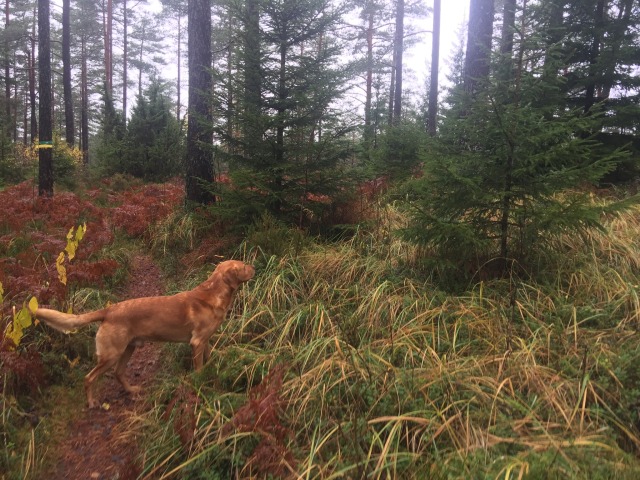
This morning the dog and I ventured into Kynnefjälls Nature Reserve on a 9 kilometre loop that was looking particularly fine on a wet autumn day. Rather like back in our valley in Lowther, there used to be, in 17 and 1800s, far more crofts and farmers’ homes here than there are now, 300 actually. These days they just lie in ruins.


Another claim to the historical fame of the area, is that in the 12th century a steadily growing group of outlaws lived here, called the ‘Birkebainame’, their name coming from the birch bark they made into a type of clothing, in the absence of anything else. They proclaimed Sverre their leader, and as they grew, for sometime he has known as King Sverre of Norway, and were a reputed force throughout Scandinavia.
Though there difference between the lowest and highest points on the trail was only 70 metres, there was plenty of up and down, reaching its highest point, at what Strava recognises as a peak, Vaktarrekullen, at 231 metres just. There is a well-equipped but unstaffed hut here, open all year around, as it lies on a long distance footpath, the Bohusleden Trail. It has 27 sections and is 340 kilometres in length, through varied countryside.
It connects to the Kuntstigen, which can then take you into Norway on the Kyststein trail. It is part of a project that will mean being able to hike from the Denmark-Germany border (Scandinavia’s southernmost point) to North Cape, all on tracks and trails, and should be ready by 2025, just over 3,000 kilometres.


Once again were fortunate with the weather. Shortly after we returned to the van heavy rain set in again. I drove south. Initially half an hour on these wonderful small roads of Dals-Ed region, to a supermarket to stock up, then an hour on the very much busier E6.
Settled in by 4 pm, I finished my current book, Quarry by Jane White, and updated my various review pages.
This is a forgotten British novel of the 1960s about three boys, two aged 17 and the other 15, who persuade a 12 year old boy to follow them to a cave in a quarry close to where they live, and tell him to stay there.
It’s a strange, disturbing and fascinating piece of literature.
The boy isn’t kidnapped, he is free to leave if he chooses, but he is in awe of the older boys, and does as they say.
The three older boys, Randy, Todd Carter, and are very much children of the 60s, their parents not really bothered that they are rarely at home, or what they do with their time. Communication between them is minimal. The adults are apathetic, the boys are bored. Though not quite sure what they will do with the younger boy, they see him as an experimental plaything.
‘The boy’, as he is known throughout the piece, has no name, and is vague whenever asked where he is from, and where his parents are.
After the boy goes wandering one day, but returns to the cave, the older trio build a cover and in effect imprison him, though this is done with mutual agreement.
Randy and Todd are approaching their final exams, soon they will join the status of adulthood. Their parents suggest various activities for the holiday, but that is met with indifference; they seem much happier playing childish games of pirates at the quarry.
But the intense atmosphere is building, and it is clear the current situation can’t last. We know it won’t end well. Rather than the boy, it is a young girl who is their first victim. She has been spying on them, and after a chase, she is run down by a motorbike.
The boy’s demise soon follows, in a remorseless scene, but there is little follow up, no grief, no guilt, no investigation, it is as if he never really existed.

It isn’t surprising that this novel shocked readers on its publication, it was compared to Lord of The Flies. Though the impact is less now, it still is a fascinating work.
Rather than it concerning the breakdown of society, I saw it more as dystopian, in that society has already broken down, and White delivers a warning as to what may lie ahead. The adults have intentionally indistinct voices. They are characters on the periphery, very much going through the motions of their dull lives, with little or no concern for their children.

 Safe Return Doubtful
Leave a comment