This was a very suitable read for International Women’s Day, a forgotten jewel in fact, though I can’t claim to have taken it on with that in mind.
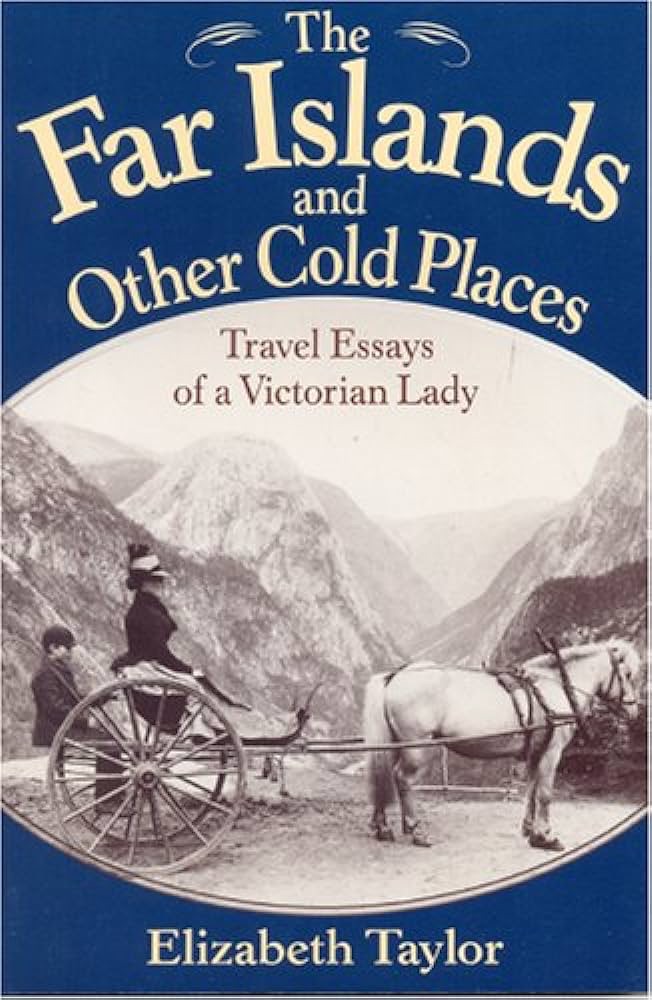
The book is a memoir or sorts, of Elizabeth Taylor, who in the golden years of Arctic exploration, refused to be put off by society telling her that such intrepid endeavours were only for men.
<blockquote>In the 1880s residents of St. Paul, Minnesota, felt insulted. An article in Harper’s Weekly said that Minnesota was a very cold place in winter, certainly too frigid for anyone to visit willingly. In an effort to counter that idea and develop tourism, city boosters determined to celebrate the cold through parades, an ice palace modeled on Mon-treal’s, and all the skating, tobogganing and sleigh riding events which could be imagined. Elizabeth Taylor (1856-1932) grew up in that St. Paul, so when she was ready to see the world she was inspired by the cold and headed north.</blockquote>
For her early twenties life became one of travel, until 1924, when she returned home. Punctuated by spells in Paris, Scotland and the Faroe Islands she was on the move, making enough to live on by writing essays for various magazines of the day. This book is a collection of them.
Taylor came to know the north of Canada well. The first part of the book is dedicated to essays from here. In 1888 she crossed the country by railroad to Sitka, Alaska, where she spent the summer hiking, kayaking and fishing. An unexpected adventure occurred on her return when the steamship Ancon struck a reef and was sunk. She and her entire group of 200 tourists had to be put ashore on a nearby island where they waited five days until another steamer, the George Elder, could rescue them.
Her articles in magazines, such as <i>Harper’s Bizarre</i> became very popular, with vivid descriptions of a landscape, that to most, they could only dream about..
<blockquote> We had camped one afternoon, on our way home, at Bechah Onegum, or Pine Portage, and the guides and I had just started in our canoe to run down the rapids to the fishing-ground, when suddenly we heard a rushing, crackling noise, which was echoed back and forth by the high trap cliffs, and looking about, startled by the confused sound which seemed all around us, we saw across the river, where the Cariboo Mountains tower above the rapids, an immense pine-tree which had become loosened from its hold in the rocks, five hundred feet above the bed of the river. It leaped from cliff to cliff, striking with a hoarse, booming sound, breaking in its wild fall many smaller trees, and was followed by them in its downward course, and by detached fragments of rocks. As we looked in won-der, we saw it strike the rapids below with a fearful crash, dashing up great waves on the steep sides of the precipice; the water foamed and hissed, the tree was broken into a hundred fragments by the fall, and the great limbs surged up and down in the waves and then were quickly hurried down the rapids to the falls below. It was a thrilling sight; we watched it all in silence; and when the last sound died away I turned to Joseph for the sympathy and appreciation that he never failed to give. As he met my eyes, he said, in a low tone:
“Windigo!” “Why windigo, Joseph?” I asked. Joseph gave his shoulders a little shrug, and took up the paddle to push the canoe off shore. “It is very quiet to-day,” he said, significantly, “and the little wind we have blows the other way.”</blockquote>
Her writing about Canada makes up about a quarter of the book, and the Faroes, a further third. This is when she is at her best.
<blockquote>For magnificent scenery the far north must yield the palm to the Selkirk range of British Columbia, or the Rockies of Alberta. But this majestic river, sweeping always to the north, the lakes of Athabasca, Great Slave, and Great Bear, the Arctic Rockies, the midnight sun, the wonderful atmospheric effects, all combine to make the journey one of peculiar interest. That it is one of much exposure and some hardships can be readily imagined.</blockquote>
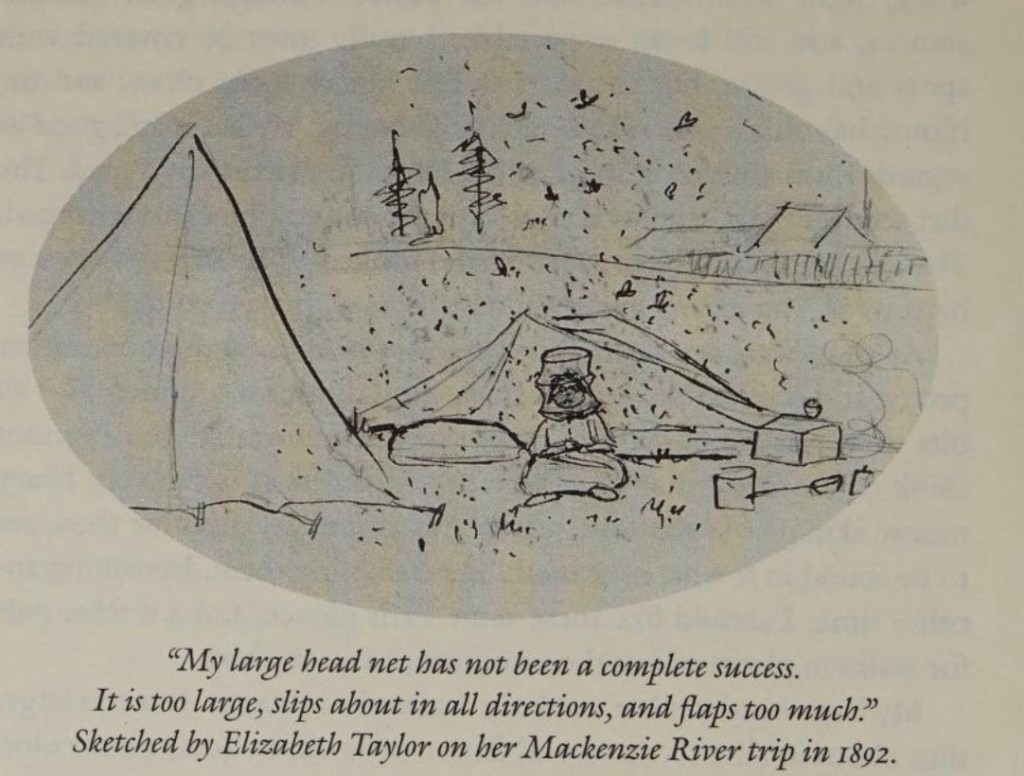
She also illustrated her writing with her own sketches, such as this one from the Mackenzie River..
Here is another from the Faroes that indicates the humour in her work…
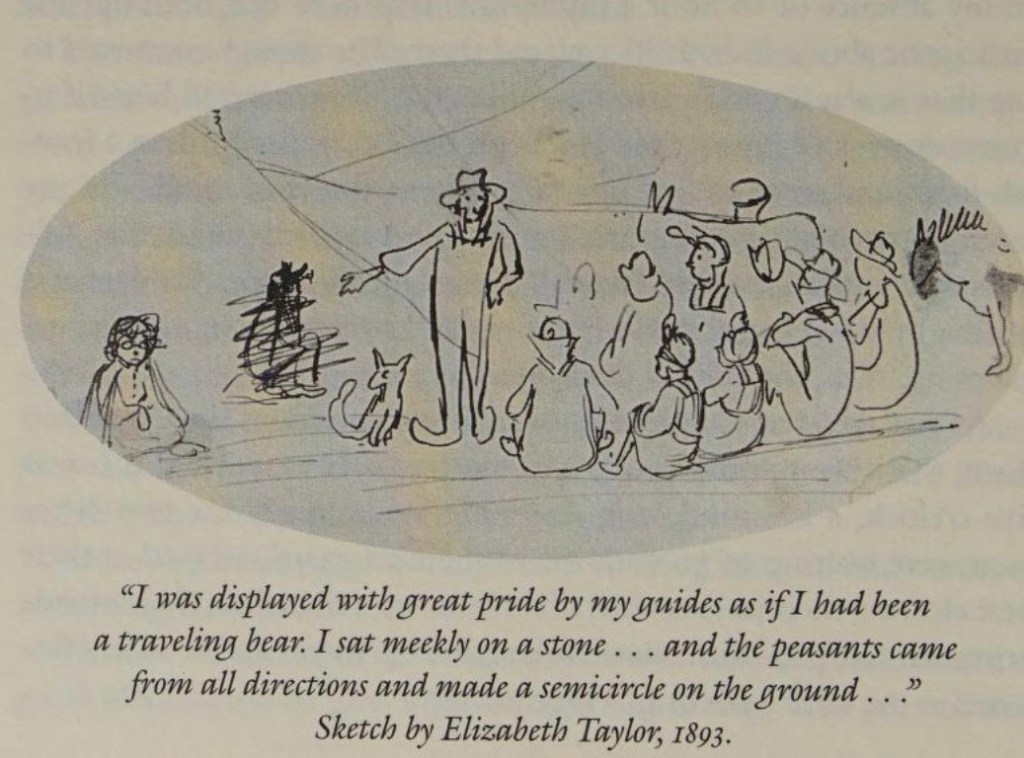
Conditions can have been far from comfortable, more so for a woman expected to conform to the attire of the day..
<blockquote>My camp dress [leaf brown checked skirt, mantle with detachable hood, blouse, full knickerbockers, gaiters and cuffs] has been just the thing, light comfortable, and has passed through great circum-stances, and still looks respectable. I really must be covered with spots and grease, but the skirt at first glance looks clean, and the blouse has only a general tolerable shabbiness. My hat is still good as regards form and color, this English felt though expensive, paid. The dirt seems to take a general tone, and the color is almost unchanged.
The silk handkerchief is all faded and looked badly in a few days of hard wear. Something else should be devised, brown preferably.
As to gloves, my stout Paris dog skin ones though good, rather pretty, and serviceable, are not thick enough for mosquitoes. Not all bite through, but enough to make one uncomfortable. But I cannot think of anything that would be better, unless it is the very heavy moose skin gloves that one sees in this country. I presume these are to be found in towns, or something resembling them. In coming another time, I should like these same Paris gloves, and a thicker pair for walks in places where the mosquitoes are very bad.</blockquote>
Taylor’s prose is crisp and to the point. She clearly has no time for sentimentality, and is most at home with people who live close to their often harsh, but always magnificent, surroundings. Their response is to invite her into the heart of their communities.
Long out of print, the book, like Taylor herself, seems to have been forgotten, and deserves rediscovery and a reprint. She emerges as a real character, a modest woman of great courage and morale in the field of exploration dominated by men.
The book is available for free on the Internet archive (archive.org).
It pairs well with <i>Christiane Ritter’s</i> wonderful <i>A Woman In The Polar Night</i>, though Ritter does write 30 years later.

 Safe Return Doubtful
Leave a comment