translated from the French by Stuart Gilbert
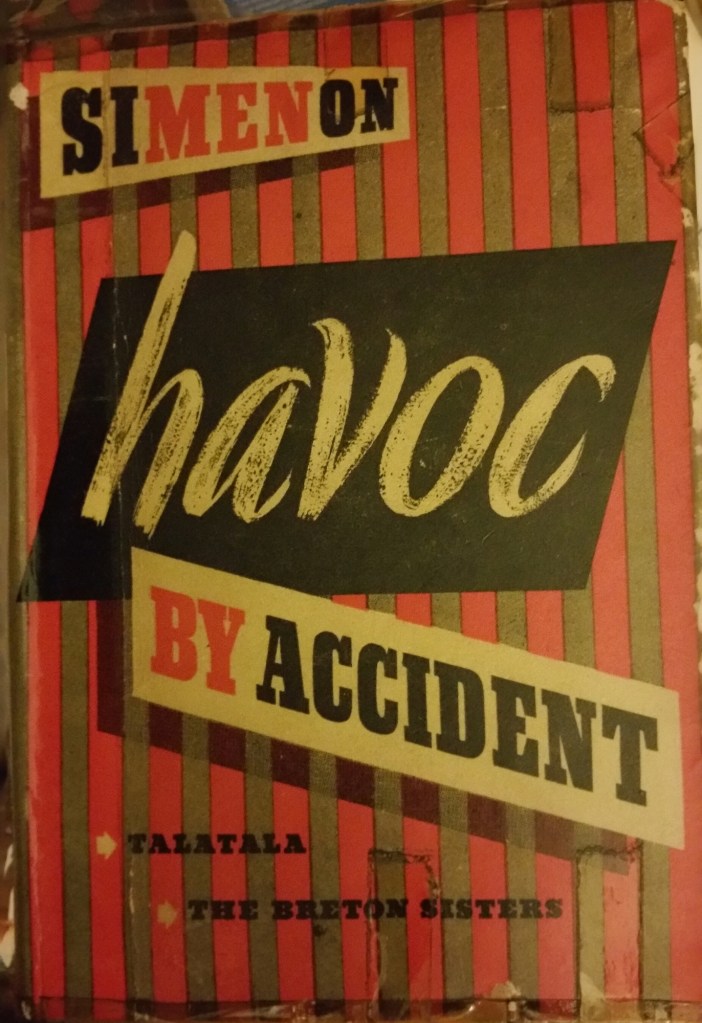
First published in 1943 as a translation, this is a collection of two shorter novels, Talatala and The Breton Sisters. It really is a book of two halves..
Talatala is one of Simenon’s African novels, and was subsequently published in a collection of three, African Trio: Talatala, Tropic Moon, Aboard the Aquitaine in 1979.
The New York Times said of it (July 1943).. Atmosphere is one of M. Simenon’s strong points, yet paradoxically, the novel which gives him the most scope in this respect–“Talatala”–is the least successful. The story takes place on an African plantation, and concerns the owner of the plantation and one of those devastating Englishwomen– rich, beautiful, well-born–whose hobbies are airplanes, opium and adultery. The hero is considerably taken with her and a few subsidiary characters shoot each other, but the story as a whole seems hardly worth the skill that is lavished upon it.
Indeed, it isn’t great. Usually Simenon’s stand-alone, those without Maigret, fit to his romans durs genre, or gritty, harrowing novels with many features of what would become the Gallic noir genre. But this isn’t anything really, and these days it suffers from being dated in its attitudes also, colonial and racist. It’s quite something, as I can’t recall reading a bad Simenon before, interesting only in that it records the attitudes of the time. Though of course, we knew those beforehand..
My GoodReads score 2 / 5.
The Breton Sisters however, is Simenon at his best.
Jules Guerec is a Breton fisherman who lives with his three sisters. One night he runs down a child in his car, and instead of stopping, chooses to drive on. His sisters, who adore him, protect him from imprudence and drain any moral doubt he shows. It may be a familiar story line, but in Simenon’s hands it is a masterpiece; writing in an off-hand manner that is far more chilling than any insistence on the horror of the situation would be, steering clear of any sort of judgement and simply presenting facts. The tension builds and the reward is a classic unsettling finale. Dependant Jules, astray and fearful that his sisters will die and leave him, makes a mental not to buy the child’s mother some chocolates. A simple enough sentence, but one in such a context that the reader is left aghast.
If anything deserves rediscovering this does. To my reckoning it was last in print in 1952. A bonus is that it is available on the internet archive, where lost gems rest, waiting to be reawoken. But, as good as it is, it would benefit from a new translation, and then I am sure, would go far..
I search hard for these out-of-print Simenon’s and, more often than not, am duly rewarded..
My GoodReads score 5 / 5




 Safe Return Doubtful
Leave a comment