translated from the Icelandic by Victoria Cribb and published in 2016
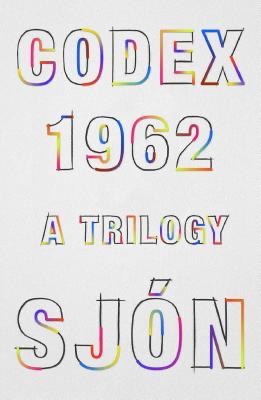
This is my last of Sjón‘s English translations and I’ve greatly enjoyed every one of them. Sjón is my favourite Icelandic writer. I’d saved this until I was in Iceland, and it went down particularly well.
Though at 530 pages it is much longer than his other work, it is in fact a trilogy, and the three parts can be read with a decent break between them if necessary. I had a break between the first and second, but then I was enjoying it too much, and the weather in Djúpivogur was so wild that I didn’t feel bad about devoting a morning to finishing it.
Above all, Sjón is a wonderful story teller, and that is the case, in spades, here. He titles the three parts, ‘A Love Story’, ‘A Crime Story,’ and ‘A Science-Fiction Story’, though there are only gestures towards the genres in their content. His writing usually flits between realism, fairytale, and the surreal, and that is certainly the case here.
In the first part, a Jewish fugitive (Leo Louwe) who, hiding with a German girl, creates a clay child, or a golem. At the end of the war, the young fugitive makes his way to Iceland.
Then, the narrative shifts into a sort of noirish mystery, with Leo Loewe caught up in a murder case that has him trying to distinguish Naziism from mere nationalism.
In the last part, our narrator, Leo’s son Jósef, enters the world, capable of remembering every moment of his life perfectly. Yet instead of telling his own story, he relates the fate of his other brothers and sisters, or the children of 1962.
The whole thing could also be seen as a series of connected short stories. There’s no traditional narrative structure here, Sjón typically enjoys playing his readers. He is stressing that the story of one man’s life is actually far more than that, it is the story of Iceland, the story of heaven and hell, indeed, the story of the whole world.
It’s a more complicated book than some of his other work, and it helps to have some knowledge of the country and its politics since 1962, the year of the author’s birth (and a year after mine..) though I looked that up on a few occasions. For example, the countries obsession with genealogy, and how it treated disabled people sixty years ago. I think Sjón, in most of his work, expects the reader to have to do some work of their own. Jozef’s story is frequently interrupted by Aleta, the woman who is patiently listening to him. She answers back and challenges, playing the part of the reader. She indirectly encourages the reader to form their own opinions of what happens at the end.
It’s a tremendous piece of literature, and I, along I expect with many other of his fans, need to be patient and wait for the next translation to be available.
My GoodReads score 5 / 5

 Safe Return Doubtful
Leave a comment