Day 54 – at Grazalema
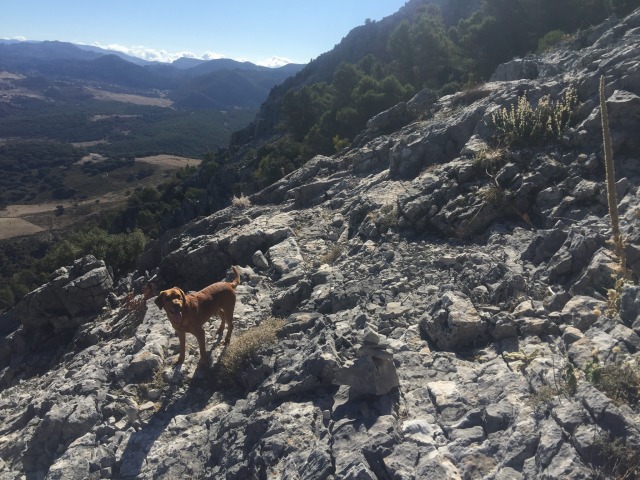
Being parked just outside the centre of Grazalema I walked in for some fresh bread and a coffee, before heading up to the statue that looks over the town, El Santo. I had conjured up a route that ascended the peak to the south, Cueva de Dos Puertas. After passing the ruin of 16th century Chapel, the path climbed steadily through the forest until emerging above the tree-line. Here, it got progressively more serious, in that it necessitated ‘hands on’ for much of the time, and had an increasing degree of exposure. My hope was that it would get easier, but it was the reverse. Such places are not great for medium sized dogs. I recall Roja being out of his comfort zone on Suilven, at the Bealach, from where we called it a day and headed back. It didn’t take me long to decide to do the same here. Somewhat frustrating, as only 100 metres or so of ascent to the summit, but unfamiliar with the territory, it was the obvious decision.


After lunch I drove up to one of the high passes, Puerto de las Palomas, at 1250 metres, on the small road to Zahara. From here it’s just a couple of kilometres walk to the peak of Coros, from which there are splendid 360 degree views.


I had considered parking up for the night at the pass, but there were signs saying it was not allowed. This National Park seems far more advanced in its conservation and access than others I have been. There are many ibex, wandering often on to the roads. There is a noticeable lack of litter, and in high season a permit is required to hike on many of the paths. In looking for a place for the night, my main consideration is to go where no one minds me going: usually away from residential properties and farmland. Here in Spain some towns direct overnight vans to a particular parking area, much more so in France, but sadly not very much at all in Britain. I opted for a parking area for walkers a couple of kilometres back down the road. Just after dark a Park Ranger vehicle pulled in and explained that anywhere in the Reserve, a word he used to indicate the most sensitive areas of the Park. It was not allowed. I offered to move, but he said I was fine for the night. He said it was better for future nights to stay in the towns and villages.
The birds of these Sierra..

The ‘buitre leonardo’ is the Griffon Vulture, of which Spain has the most in Europe. When this National Park began, in the 1980s, they were is serious decline, now there are more than 25,000.
The ‘aguilla azor perdicera’ is the Bonelli’s Eagle, of which in the 1990s there were less than 900 pairs in Europe. They have recovered their population somewhat, but only in protected areas like this.
The ‘aguila real’ is the Golden Eagle, and the ‘halcon pelegrino’ the Peregrine Falcon.

 Safe Return Doubtful
Leave a comment