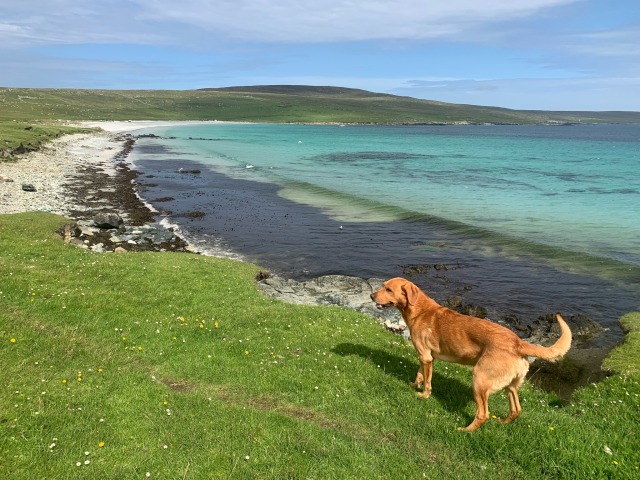
Just across the hill from Mu Ness Castle is Easting Beach. Parking is at Hannigarth, a spectacularly situated holiday rental property. From there it is just a kilometre’s walk across the field to the sands of Easting.


My exploits today began here. These days are with a strong, like 30 mph, northwesterly wind blowing, which keeps things cool. I’m on the eastern coast of Unst hoping it will be less exposed to the gale’s teeth, but if it was any less strong, it was only by a fraction of a mile per hour.


It was still quite wonderful on the beach, and after some time there I continued around the coast, vaguely north, on some lesser cliffs, or about 10 metres only, home to several otters, the first I’ve seen on this course. Roja’s first thought is that they need chasing, they are a game, on the planet for his fun only. I call him sharply. He ignores, but hears the whistle, which I only use for matters of great importance. He comes, sulkily, already knowing his mistake. He sits, a few centimetres away only, and I tell him clearly, four times, ‘no’. Behind him I see the pair of otters, back to where they were, chasing each other around the rock. Perhaps I was wrong, maybe they are here just for fun. But I’m satisfied that my dog didn’t scare or threaten them. From now on he is more placid, and respectful.


After about three kilometres the abandoned village of Framgord can be seen, a couple of hundred metres inland. I’m interested by such villages, I have not long ago read and thoroughly enjoyed Matthew Green’s Shadowlands, subtitled ‘a journey through Britain’s lost cities and abandoned villages’. Framgord doesn’t make the cut, but it does have an appealing story. There has been a community at Framgord since the Iron Age, the remnants of two Pictish houses and a burial ground are nearer to Easting beach. A bit further along are ruins or a Viking settlement, though some of this has been eroded with the coastline. The Viking graveyard, set back off the beach, and with no road to it, is still in use today. There are also the remains of a longhouse.
In the 1800s fishing communities were no longer profitable to the lairds. Prior to this tenants had sold their fish to European traders. The lairds turned their attention to sheep farming, and evicted tenants who grazed their animals, as they had done for centuries, on common land. Though the most devastating clearance was on the island of Fetlar in the 1860s, where I will be next week, Framborg suffered similarly.

Wandering amongst the abandoned and ruined houses, the locals say that as the wind whistles through, conversations of the day can still be heard, the ghosts of the crofts warning each other of the starvation that was to follow, or of violent eviction.
Here’s that holiday let at Hannigarth. I’ve got my eye on places like this to spend 12 weeks of winter at in the next few years. My idea is to offer the owner a set sum for that time, when most likely they will have few clients. It has a wonderful location.

After lunch I headed north, through the metropolitan centre of Unst, the few houses that make up Baltasound, with its primary school, cafe, shop and leisure centre. Here’s the shop..

It’s another 15 minutes up to the northwest corner of the island, Hermaness Nature Reserve, where I parked up for the night in preparation for an adventure tomorrow, took a walk to the pier below, and settled in for the evening.



 Safe Return Doubtful
Leave a comment