translated from the Spanish (Argentina) by Nick Caistor
This was Aira’s first novel, and having finished it I was interested in how it went down after it was first published. It was written in 1991, translated into English by Nick Caistor, one of his regular translators, in 1997. It was to be nine years until the next translation, An Episode in the Life of a Landscape Painter, so my guess is that it wasn’t received that well.
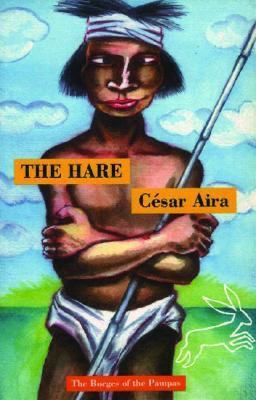
The Hare is his longest novel, and has quite a sprawling plot. It concerns a British expedition to a remote Mapuche Indian tribe led by Tom Clarke, a young naturalist and the brother-in-law of Charles Darwin. It takes place during the Federalist dictatorship of Juan Manuel de Rosas. Its cast are of artists and outlaws, gun-toting bandit wives and a colourful group of natives. The 70 year old Mapuche chief disappears, and Clarke is co-opted into the search party for him.
The novel was reissued in 2013, after readers knew something about the author, and was much better appreciated. Fans of Aira (of which I am one) need a taste for the absurd, patience for his covertly philosophical tangents, and not being concerned with laughing at loud at seemingly inappropriate moments. He is prolific, writing 2 to 5 novels annually, amounting to more than 90 in total currently, and though the translations are a little behind the Argentinian timeline, they are catching up. The genres he writes in, from memoir, to horror, to historical fiction, are varied and often cross. It is impossible to predict where the story will go.
So, considering this, The Hare, having read a wide selection of his other work, it is much easier to appreciate its bizarreness – Clarke, searching for an mythical rabbit that not only jumps but flies, the two Argentinians that ride alongside him, a verbose 15 year old and a reticent gaucho with his own reasons for tagging along. Clarke gets more and more involved with tribal politics, so much so that he is declared their commander, and the day after, war breaks out.
Typical of Aira is that the plot is not to be taken seriously. Clarke’s journey through the pampas resembles editions of Star Trek, lengthy rides through desert landscapes interrupted by meetings with extraordinary grotesques; one tribe live for sex alone, another barter coal for strong alcohol, another speak only in ‘monstrous sentences’ intended to be incomprehensible. Clarke seems to revel in this company, his strategy to win the war is called the ‘Great Sine Curve of the Mapuche armies, a line that would have exploded the maps if anyone had tried to trace it’.
With hindsight, I can see why Aira keeps his novels short. There’s something of an overland of eccentricity here. It’s a bit much to take in, especially if this was the first Aira novel one read. It’s also a bit light on humour.
But great writers need to start somewhere, and this is entertaining and very definitely bears many of the trademarks readers were to go on to enjoy so much.
My GoodReads score 4 / 5

 Safe Return Doubtful
Leave a comment