British Science Fiction / Satire – Published 1979
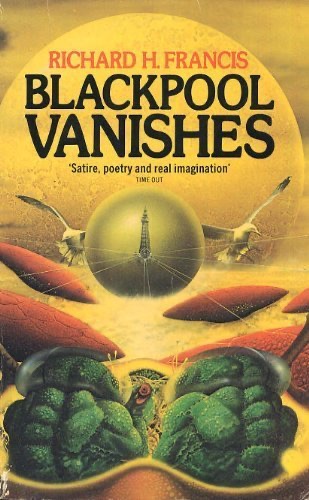
It’s rewarding to discover a neglected novel, particularly one which had limited success on publication, and would stand well if it were to get a reissue. I’m only the third person to review it on GR, and the first positively. Mind, that may say more about me than the book itself..
Such is the case with Richard Francis’s first novel, published and set in the late 1970s, a time when UFOlogy was in its golden age.
When Stone first saw the flying saucers from the Promenade he assumed, as UFOlogists usually do, that they were large and high up, well above the Tower.But he soon realised that they were actually tiny, just over an inch across and flying three feet above his head. No one else noticed them and even when Stone pointed them out to his boss at work he was brushed off and told that they must be midges.
Of course, if anyone had believed Stone at the time, he might never have written a poem about the event, or the other sightings he went on to see in the next few years. If he hadn’t sent the poems to the Foreign Office, James Aldridge of the Alien Beings Section would not have had the vital clue to the sudden disappearance, in the summer of 1976, of the entire town of Blackpool.
Aldridge then becomes one of the most important men in the country, but no one can reach him. He is under arrest, suspected of the savage murder of Barnet, his head of department. Meanwhile, the only other man to know the secret of the Stone Report, the mysterious Marcroft, is lying dead in the reading room of his London club, seemingly killed by a telephone call.
The plot is one thing, humorous and ridiculous, science fiction of a kind, but the sheer quirkiness of Francis’s characters is the real reason to read and enjoy this novel. Quaint folk like like Tom Standish, Bill Caudle, and Miss Nym, who when needing to travel they board railway trains and find themselves in places called Boddington, written out in pansies on the station flower-bed, where the ticket collector wears a pocket watch. In a state of mild-mannered confusion they meander through the plot helplessly and doing very little, around the vacuum of nothing that once was Blackpool. Another favourite is Bill Wentworth, returning to the main set of Jeux Sans Frontières, on which he commentates for the BBC (as well as Rugby League), from a set in Ravenglass in the Lake District; a version of Eddie Waring perhaps.
I mentioned that the plot was of secondary importance, indeed nobody really takes much notice of the catastrophe. As they vanish, Blackpool’s residents come over all queer for a bit; then, shaking their heads, turn back to their unfinished business. Later, when it’s all over, they wander home to watch it on Nationwide.
It seems that a reason for its lack of success on release was that it was taken to literally. Fellow authors didn’t like it and nor did the science fiction community. Brian Aldiss even called it a ‘cosy catastrophe’. I think they missed the point, it is satirical and mocks the hysteria that the supposed sightings of the seventies caused.
It’s just really good fun..
My GoodReads score 4 / 5








Leave a Reply